Podcast: Play in new window | Download (Duration: 32:59 — 30.2MB) | Embed
Don't miss out on the latest episodes. Subscribe now! Spotify | More

Karen White is best known as the top selling author of so-called “Grit Lit” – the mysteries with a paranormal twist set in the South, like her Tradd Street series set in Charleston, South Carolina, or family sagas in Georgia. Her latest book, in contrast, The Last Night in London, is, as the title suggests, a departure – the first book she has set outside of the South.
Hi there, I’m your host, Jenny Wheeler, and in Binge Reading today Karen talks about why she wants the full gamut of human emotion in her stories – laughter as well as tears, love as well as hate – and she shares how she confronted the dark period of her career when she almost gave up writing fiction altogether.
Support Binge Reading on Patreon for as little as a cup of coffee a month and receive regular exclusive bonus content on featured authors and the making of the podcast.
Bonuses include regular weekly Getting To Know You Five Quickfire Questions with authors including Karen, giving a fund candid snapshot of their likes and dislikes, as well as an exclusive monthly Behind the Scenes newsletter giving previews of upcoming books. You can join and get this bonus content and having the satisfaction of knowing you are helping pay some of the hosting and production costs for the show. The time I give to the show in sourcing guests and researching their books is still free. Become a Patreon supporter today by going to https://www.patreon.com/thejoysofbingereading/
Six things you’ll learn from this Joys of Binge Reading episode:
- The book that “saved” Karen’s author career
- Karen’s long love affair with the South
- How she’s moving on from Tradd Street
- Her fabulous collaboration with two other best selling authors
- Why she values stories that tug at our heart strings
- How fashion helped maintain morale during the Blitz
Where to find Karen White:
Website: https://www.karen-white.com/
Instagram: https://www.instagram.com/karenwhitewrite/
Facebook: @KarenWhiteAuthor
Twitter: @KarenWhiteWrite
Pinterest: @karenwhitebooks
Goodreads https://www.goodreads.com/author/show/160033.Karen_White
What follows is a “near as” transcript of our conversation, not word for word but pretty close to it, with links to important mentions
But now here’s Karen.
Jenny Wheeler: Hello there, Karen and welcome to the show. It’s great to have you with us.
Karen White: Hello, Jenny. Thanks for having me.
Introducing Karen White author
Jenny Wheeler: You’ve got more than 30 books published so a fantastic backlist, and it’s a mix of best-selling and award-winning historic fiction, mystery with paranormal twist, and women’s fiction – quite a mix there. But it would be fair to say that they’ve probably all got one thing in common and that is they are emotional family stories, or there’s a lot of emotion built into them, isn’t there?

Karen White: Yes. I like to write the kind of books I like to read, and I like to read books that pull on all the heartstrings. I want to make you laugh, but if I make you cry, or if I make you think, that’s a bonus as well, because that’s real life. That’s what we’re all going through.
Jenny Wheeler: Your latest book is on the verge of being published in the U S. It’s The Last Night in London, a time slip story moving between the present day and wartime London. You set up a web of fascinating links between two women, one a fashion journalist in 1940s London, and the other a New York photojournalist in the present day.
It’s quite surprising that the fashion industry even continued during that very chaotic period of the war but tell us about the genesis for the story.
Karen White: This has been playing in the back of my head for many years. My first two books were historical fiction, both set in the American South. Then I switched to contemporary fiction and I wrote them all set in the South. There were two of my most popular books, Falling Home and After the Rain, that were published in the early 2000’s.
Following on from Falling Home
I thought I was done with those books, but over the last decade I’ve been getting so much fan mail and emails from readers who are asking me what happened to Maddie Warner. Maddie Warner is a 14-year-old girl, the daughter of the family – this large boisterous Southern family in a small Southern town in Georgia, in Falling Home.
Then it’s four years later, so she’s an 18-year-old young woman graduating from high school, getting ready to go to college, or university – wherever you are, that’s what you call it. Her life is ahead of her, although she’s had some sad things happen in her past and her future is not all that certain.
I left it at that because I thought those stories were told. But people keep asking what happened to Maddie Warner. I love that character, I love the whole cast of characters from both those books, and I wanted to go back. I just didn’t know.
Then the other thing is I lived in London for seven years. I lived in this beautiful Edwardian building on Regents Park. My father was with Exxon, so that’s why we were there. I loved the history of it.
The day we moved in I remember the porter telling us the reason why some of the windows were plain glass instead of the beautiful leaded glass that so many of the windows had, was because during the Blitz there had been nearby bombings and they had been shattered.
Always a history buff & reader
I wasn’t a writer then. I had no intention of being a writer. That’s something I fell into later on. But I was a reader, and I had an active imagination and of course I could not sleep at night in that building without wondering about the lives that had transpired since it was built in 1904, and during the Blitz, my goodness.
I’d always loved history. My father was a history buff and so he and I shared that love. It truly was my first experience with holding history in my hands. It made it personal to me. My mother was from Southern Mississippi and I remember when we moved to London, people laughing at her accent and giving her a hard time. We lived in other places as expatriates, but I love those fish out of water stories, so I wanted to tell the story of a Southerner in London.
I thought, I’ve never written a book set in London. I was waiting for the right story, the right character, and of course it happened with Maddie Warner and my building in London, because both the historic period and the contemporary period in the book are set in my flat in London.
Jenny Wheeler: It’s wonderful because this book does have quite a sense of the Georgia family and what a Southern family is like, even though there’s only a tiny bit of it that’s actually located in the South. Most of it takes place in London, but the phone calls from home, et cetera, are always intruding into the scene, so you still get quite a strong sense of those family links.
I must admit that after I’d read this one, I had to go back and read Falling Home. I wanted to know more about this family. I think you are probably going to get quite a few readers who are going to do that – go back to the earlier books as well.
Intriguing Precious Dubose
Karen White: I hope so. I’m making it very clear that this is not a sequel. You do not have to read Falling Home and After the Rain to read this book and know who people are and what’s going on. There’s actually another character, a main character, Precious Dubose.
I write collaborations with two other New York Times bestselling authors, Lauren Willig and Beatriz Williams. We had a book out last year called All the Ways We Said Goodbye, set in Paris during three different time periods. And we meet Precious Dubose for the first time. It’s 1964.

She is a beloved character in that book. We got lots of reader mail about her. She hints at a past from her war years that she doesn’t want to talk about, but there’s a lingering sadness there and you don’t know what that story is. In The Last Night in London we see Precious again and get to know that past. We also get to meet her now as a woman about to turn 100, sharing her story with Maddie.
Jenny Wheeler: It’s diverting a bit from The Last Night in London, but when you wrote that part of All the Ways We Said Goodbye, did you know yourself what Precious’s backstory was, or did you have to get to grips with creating that after the other book came out?
Karen White: Because we wrote that book together, we don’t admit who writes what part. We each add so much to each character. I think we all decided together, because I needed a character like Precious Dubose in the book I was working on at the same time, and both Beatriz and Lauren said, why don’t you use Precious? At that point, I didn’t know what that background was.
Shared collaboration as authors
And the ending had already been written for All the Ways We Said Goodbye. Then we got together to do the final read through and discuss it, and we came up with this amazing plot twist that had to do with Precious. I’m not going to give anything away. So people who want to read that book, it tells you what the big deal was in World War II with Precious.
To see her now, to see her look over her life and all the things that happened at that point and talk about it to Maddie and share what she’d learned and what she regretted and all of that – I think it’s such a fascinating way to write about a character.

Jenny Wheeler: It raises an interesting issue. It’s wonderful that you’re friends, but that’s really shared IP, that they have now allowed you to take on and use in something else, isn’t it, which is quite an interesting thing that’s developing with this whole new publishing world.
Karen White: Absolutely. Beatriz, Lauren and I – Beatriz has, they’re not a series, just interlocking characters, and that’s the Schuyler family. And Lauren has more than once said, I need somebody in New York city at this time, and so she’ll say, I’m going to borrow this character.
They are kind of placeholders, not like main characters of course, those belong to the author, but it makes this fictional world very, very real. Several times in different books we have used characters, or dropped a name or whatever, and made reference to them because it’s so much fun to do.
Dual time line – and an exhibition
And all three of us have included a law firm called Willig, Williams and White, which is our three last names. Not everybody catches it, but when they do they go, oh, yeah.
Jenny Wheeler: Oh, that’s great fun. Maddie, in The Last Night in London is a photojournalist who’s commissioned to do a piece on wartime fashions for a museum exhibition.
This is how she discovers Precious still alive and about to celebrate her 100th birthday. But in the course of the book there’s wonderful detail about the fashion items – the gowns they choose for the exhibition, the shoes, the bags, and in fact, there’s an evening bag that plays quite a significant part in the story. Was that side of it fun to research? Have you done fashion stuff before?
Karen White: I have not. My link to beautiful, beautiful gowns and fashion was from my grandmother’s trunks in her Mississippi house. My grandmother had five daughters growing up in the fifties in the deep South. If you can even imagine the dresses they have.
My grandmother saved them all with tissue, and the long gloves and the handbags, the head fashions, everything. My girl cousins and I would be ecstatic when we’d go visit our grandmother, because she would let us put them on and it was our own little fashion show.
So I’ve always had an interest. Then while I was researching this book – I don’t always, in fact I rarely know what’s going to happen in a book, and I didn’t even know about the fashion angle until I was researching other stuff about London during the 30’s and 40’s – and I came across a novel.
The 1930’s London modelling scene
I want to give you the title of it – no, I’ve already put those books away, but it was a novel written in the late 30’s about a girl in a working-class family and she gets a job working as a model for a small fashion house.
And I read it. That’s where I got so much of that – what the models are talking about and how they got changed and ready for show, and what that felt like. That was incredible because it was written during the time, so how much things cost and all of that. She gets an apartment or a flat and has a roommate and how much that costs. It was such an eye opener.
Then at the same time I came across a coffee table book that had been written to go along with an exhibition somewhere, one of the art museums in London, and it was called Elegance in an Age of Crisis. It showed all these gorgeous gowns. I was just shocked that this was wartime, but people were still dancing. They had to be more careful about it, but there was also the romance of it – the men in uniform.
We always like to romanticize war. There’s nothing less romantic than war, but back then I guess maybe it was that edge of danger and they would go to the Café de Paris, which is in the book and that’s a real place and it really was hit by a bomb and lots of people died, and they continued to dance.
It was the thing to go out and be glamorous. It really was an exciting time, and I was mesmerized by both these books, that this glamorous life could continue in such a fraught time, such a dangerous time.
Looking beautiful patriotic duty
Jenny Wheeler: In the book it almost feels that way – celebrating and continuing to look beautiful is a way to respond to Hitler, to show him that they’re not going to give in. There’s definitely that undercurrent in it, isn’t there?
Karen White: Absolutely. And the red lipstick, because Hitler hated makeup on women. I’d like to think that was part of the British people’s way of saying, go away. I wanted to say an expletive, but I won’t because of the general audience.
But the whole of Europe was looking at England as their last hope. There’s a fabulous book that I read, Last Hope Island by Lynn Olson. It is non-fiction, but it was all about how Europe fell, how the exiled governments were all in London and Winston Churchill was like, okay, so we’re being bombed, just keep calm and carry on.

And the people did that. That meant putting on your red lipstick, it meant curling your hair. It meant, if you can’t get nylons, same in The States, you’re going to draw the line down the back of your legs and you would make do, because you were doing it for the boys basically.
It’s very sexist now, but back then women were not allowed into combat so that was our way of showing Hitler and showing our support for the boys and also doing our part. By ‘our’, I mean females. They played such a large part in the war effort and did their best to look good while doing it.
Jenny Wheeler: There’s even a hint that the government is in favor of this because of the improved morale when there are lovely women around.
Karen White: I know, and again very sexist, but it worked. Vogue magazine continued to put out magazines throughout the war, even with the paper shortage and everything else, because the government knew that keeping women excited about fashion – they might make their own clothes out of whatever they had to look fashionable, but they knew that keeping up the women’s morale would also help with the war effort because they were looking good for the guys.
Serving up Southern slang
It would also keep the economy going because they would try to buy what they could and then make do, trying to look like these fashion models in Vogue magazine.
Jenny Wheeler: One of the things I loved listening to in Falling Home on audio particularly, although it’s the same in this book, is your good way that you pick up on colloquial speech. Of course, there are wonderful southernisms in Falling Home, but in The Last Night in London you’ve got the same thing with the British, the little British ways that they talk.
With Falling Home, it was things like dagnabbit, which I’d never heard before, and that dog won’t hunt, that kind of thing. Do you have a particular ear for conversation? Are you one of those people who sits in cafés and eavesdrops?
Karen White: Most definitely. Maybe because I’m a musician. I’m one of those people who could sit in a crowded café and there could be some faint music playing on the sound system, and I will be able to pick it out, sing along to the lyrics, tell you when it came out and what the title of the song is and who sings it. I have a good ear and I think it is because I’m a musician.
I also can mimic accents. I’m not going to try my Kiwi accent right now because it’s not practiced, but I can do a Cockney really well. When I lived in London – my goodness. Not only do I listen to what they’re saying, but how they’re saying it. My favorite was from commercials, Wall’s pork sausages. I could do a whole commercial with my Cockney accent. I’ve actually been complimented by a London cab driver.
Nothing like the South!
My mother’s family and my dad, they’re both from Mississippi and you don’t get any more southern than Mississippi. I lived all around the world. Even though I’ve lived in Georgia now for almost 29 years, when I’m around Southern people my accent gets a little twangy but oh my goodness, listening to my cousins.
I remember a copy editor from New York was doing the copy edits for Falling Home. Sam says something like – this is kind of rude, but it’s in the book and it is a thing – he’s like a booger you can’t thump off. And the copy editor was like, there’s no way somebody would say this. And I’m like, yeah, call my cousin Nathan, because that’s where I heard it.
And another one – I got a comment from this book – when they’re back in Georgia, somebody, I think it’s Maddie, says, is a frog’s butt watertight? This reader loved it so much she sent me an email and I made coasters with that and now I’m going to send her some.
Jenny Wheeler: This one also – he’s slicker than pig snot on a radiator. That sounds like it was in The Last Night in London or Falling Home.
Karen White: Once you get into deep South. That dog won’t hunt, I’ve heard that recently. That’s like, it’s not gonna work, you know?
Jenny Wheeler: It’s great that we’ve moved on to talking about the South because you’ve got a whole lot of very popular mysteries, the Tradd Street Mysteries. Tradd Street, with a double ‘d’ for those who aren’t familiar with Charleston and the South. It’s Southern fiction with a paranormal twist and Tradd Street is one of Charleston’s most historic streets.
The Tradd Street Spinoff
It features a psychic realtor called Melanie Middleton, and you have said online – I thought it was amusing – that you can’t confirm or deny that Melanie is an exaggerated version of yourself.
Karen White: I will neither confirm nor deny, no.
Jenny Wheeler: It was quite striking to me that I saw it described as low country. To me immediately, low country means The Netherlands. I didn’t realize that part of the States also had that description. So it’s quite low lying obviously.
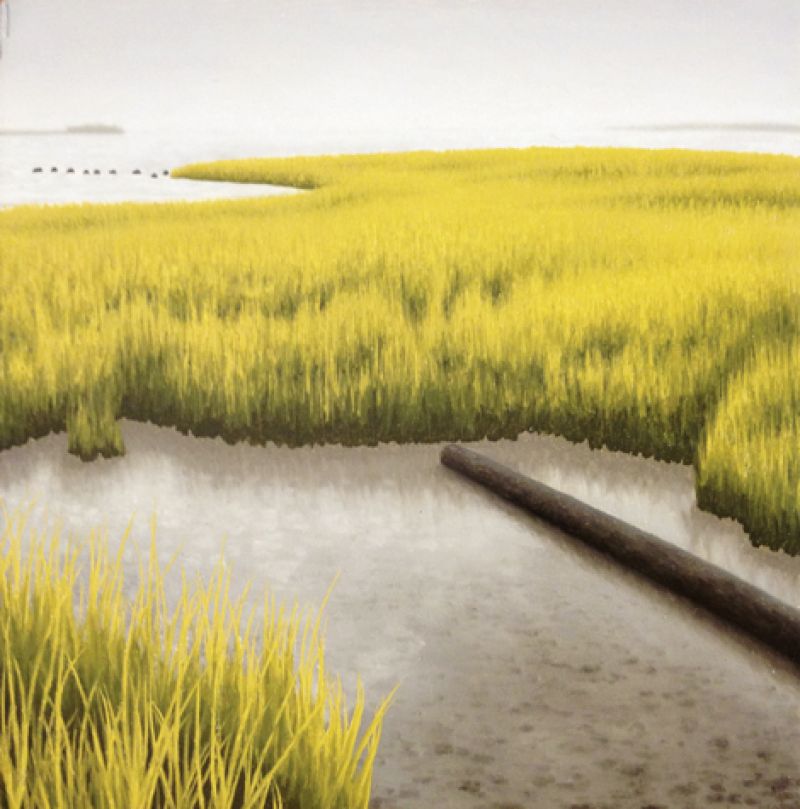
Karen White: Very, yes. It’s below sea level, which is why it does have a tendency to flood. That’s why hurricanes are always so feared in that part of the country. Except, instead of having the lovely areas that you’re familiar with as being low country, low country means lots of mosquitoes, lots of snakes, alligators. But I think that just makes it so much richer.
Maybe it’s my Southern heritage, but I love the smell of the swamp. I love all of that. There a thing called pluff mud, which is basically the marsh mud at low tide. It has this very pungent smell and my husband, who’s from New York, says it smells like sewage. To me it smells like home. So I guess we’ll never live in the low country.
Jenny Wheeler: Is Tradd Street still continuing or has it come to an end?
Karen White: Well, here’s the story. It was only supposed to be two books at the beginning, and then it was so popular they asked me to write more and more and more and more. The seventh and final book, called The Attic on Queen Street, will be out this November 2nd, so I have two books out this year.
Last of Tradd Street series coming
It will be the last in the Tradd Street series, but we were getting so much, not flack, but just, oh please tell me it won’t be the end of this series. I was like, I need to let Jack and Melanie and all those characters rest and have a good life and let them alone, because I keep on messing with them. So I talked to my editor and my agent and we were, you know what, let’s do a spinoff and let’s set it in another fabulous Southern city.

It’s going to be set in New Orleans and I’m taking one of the major secondary characters in the series, Nola, who’s Melanie’s stepdaughter, and she’s going to be the main character in the spinoff series. The first is called The Shop on Royal Street and it will be out in the Fall of 2022. That is the book I’m working on right now.
Jenny Wheeler: Do you find when you do a spinoff like that, that it gives you a whole fresh flush of creative energy to have a new character to work on?
Karen White: Oh, yes. I’m having so much fun. I have not had this much fun writing a book in a while. I think also because I went to Tulane University in New Orleans. I lived there for four years. I have lots of friends there.
It’s like with London, I’m coming home again, so I’m very excited about writing about it in a post-Katrina world. I lived in New Orleans before hurricane Katrina, so because I believe in suffering for my craft, I’ve already planned a getaway trip with my husband to New Orleans, to do “research”, eat at all the restaurants and do all that tough stuff.
A New Orleans setting for new series
I need to get a feel of what it’s like today, because it’s not the same as it was but it still has that charm. New Orleans has a vibe just like Charleston has a vibe – very different but very pungent and very tangible. And I love exploring.
Jenny Wheeler: You have a wonderful way of creating place, so I’m sure it’s as good as going there for people who can’t travel.
Karen White: I hope so.
Jenny Wheeler: We are starting to come to the end of our time together, so turning to Karen as reader. I always like to include this section because we are The Joys of Binge Reading, and I’m hoping that people listen to us partly to get suggestions for new books they’re going to love. What are you reading at the moment and what would you recommend to listeners?
Karen White: Oh, my goodness. I’ve been doing so much reading, loving everything. Where do I start? I just finished Stephanie Dray’s The Women of Chateau Lafayette – amazing historical fiction, if you love historical fiction. I also just finished reading Band of Sisters by Lauren Willig, also historical fiction but World War I, a true story that she discovered while researching All the Ways We Said Goodbye.
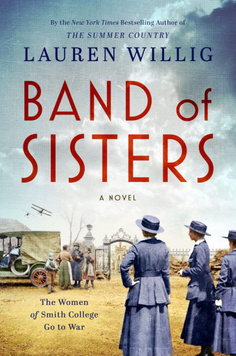
She was looking at Christmas customs in World War I France, and she found mention of this relief unit from Smith College and a huge cache of letters, which is a researcher’s dream, and was able to create this lovely, lovely, amazing book.
And then I just finished listening to an audio book, because I’m a huge audio book fan. It’s called Ghosted by Rosie Walsh.
My goodness, what a great writer, I had no idea. The characters – you’re feeling everything, and there are so many twists and turns, but it has such an amazing ending. You have no idea until the last page where it’s going. I’ve never read her before. I’ve got to find more books because it was fabulous.
If Karen was doing it all over again?
Jenny Wheeler: That’s exactly what the binge reading thing is all about. When people find an author, they can then go and look for their backlist.
At this stage of your career, if you were doing it all over again, what would you change, if anything?
Karen White: You know what, even though I’ve been through some downturns in the beginning of my career, I wouldn’t change a thing because with everything in life I think you need to have those down spots to really know, to really figure out what you want, and your own worth. You have to fight for it, and if you’re not going to fight for it, you’re never going to get out of that trough.
But I did. Do I ever want to go through that period again where I was dropped by my publisher, I didn’t think I’d ever write again, but my agent was like, no, no, that’s them not you. You’ve got this great book and I’m going to sell it. And she did. That was my first book with Penguin, and that’s when my career really took off.

I’m so grateful for that, but it was disheartening. I almost stopped writing because I’d had four books under my belt, hadn’t really gone anywhere and I was disheartened. But I learned from it.
Jenny Wheeler: What was that book that saved your career?
Karen White: The Color of Light. That was my first Low Country book set in Pawleys Island, South Carolina.
Jenny Wheeler: Wonderful. What is next for Karen the writer at this stage? What are you working on in terms of your current projects?
What Karen is working on now
Karen White: I’m starting that new series set in New Orleans and I have another idea. I’m in between contracts with Penguin, because they were like, okay, we’re ready for your next single title, and I was having some other stuff going on in my life. I’m like, I can’t think right now. It was coronavirus. It was 2020. I’m like, all I can do is think about this series.
But when you’re not thinking about something is when my best book ideas come to me and I have a doozy that I’m ready to start. I’m going to put a phone call in to my agent and see if we can go on. I can’t tell you anything about it because before I’ve started, I can’t share anything.
Jenny Wheeler: No. Of course. I understand.
Karen White: At least we’ll have two books from that series, and they will be boom, boom, 2022 and 2023. Those are my next two books.
Jenny Wheeler: Wonderful. Thank you. I’m sure you enjoy hearing from readers because everything you’ve said indicates your readers love to respond to you. Where can they find you online?
Karen White: The easiest place is my website, karen-white.com. And on there are all the links to my Instagram, which is at karenwhitewrite. My Twitter’s also at karenwhitewrite, and Facebook, which is author Karen White.
Where to find Karen online
Jenny Wheeler: Are you active on social media?
Karen White: You have to be, yes. If I had nothing to do all day but be on social media, I would love it, I would have so much fun. But it is the rabbit hole of the day because once you get started, that’s it. You look up and it’s four hours later and you’re like, what have I just done?
Jenny Wheeler: That’s so true. Thank you so much. It’s been fabulous talking today and we will look forward to that New Orleans series with a great deal of anticipation.
Karen White: Thank you. Thanks again.
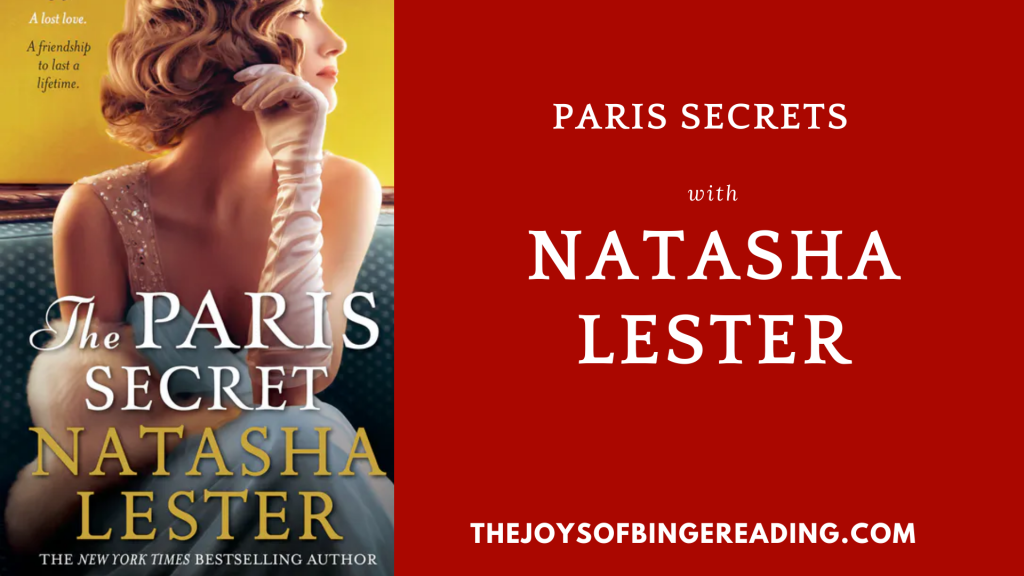
If you enjoyed Karen’s World War II story you may also enjoy Natasha Lester’s Paris Secrets, another World War II story involving the fashion industry.
Thanks To Our Technical Support:
The Joys of Binge Reading podcast is put together with wonderful technical help from Dan Cotton at DC Audio Services. Dan is an experienced sound and video engineer who’s ready and available to help you with your next project… Seek him out at dcaudioservices@gmail.com or Phone + 64 – 21979539. He’s fast, takes pride in getting it right, and lovely to work with.
Our voice overs are done by Abe Raffills, and Abe’s another gem. He got 20 years of experience on both sides of the camera/microphone as a cameraman/director and also voice artist and television presenter. Abe’s vocal delivery is both light hearted and warm and he is super easy to work with no matter the job. You’ll find him at abe@pointandshoot.co.nz